Smartphones now hold more evidence about a person’s life than almost any other object they own — location history, deleted messages, browsing activity, app data, and metadata that can place a device at a specific place and time down to the minute. That makes mobile phone forensics one of the fastest-growing disciplines in Florida’s legal, corporate, and law enforcement landscape.
This guide explains what mobile phone forensics is, how the process works, how it’s used across Florida courts and industries, and what to look for when hiring a qualified examiner in the state.
What Is Mobile Phone Forensics?
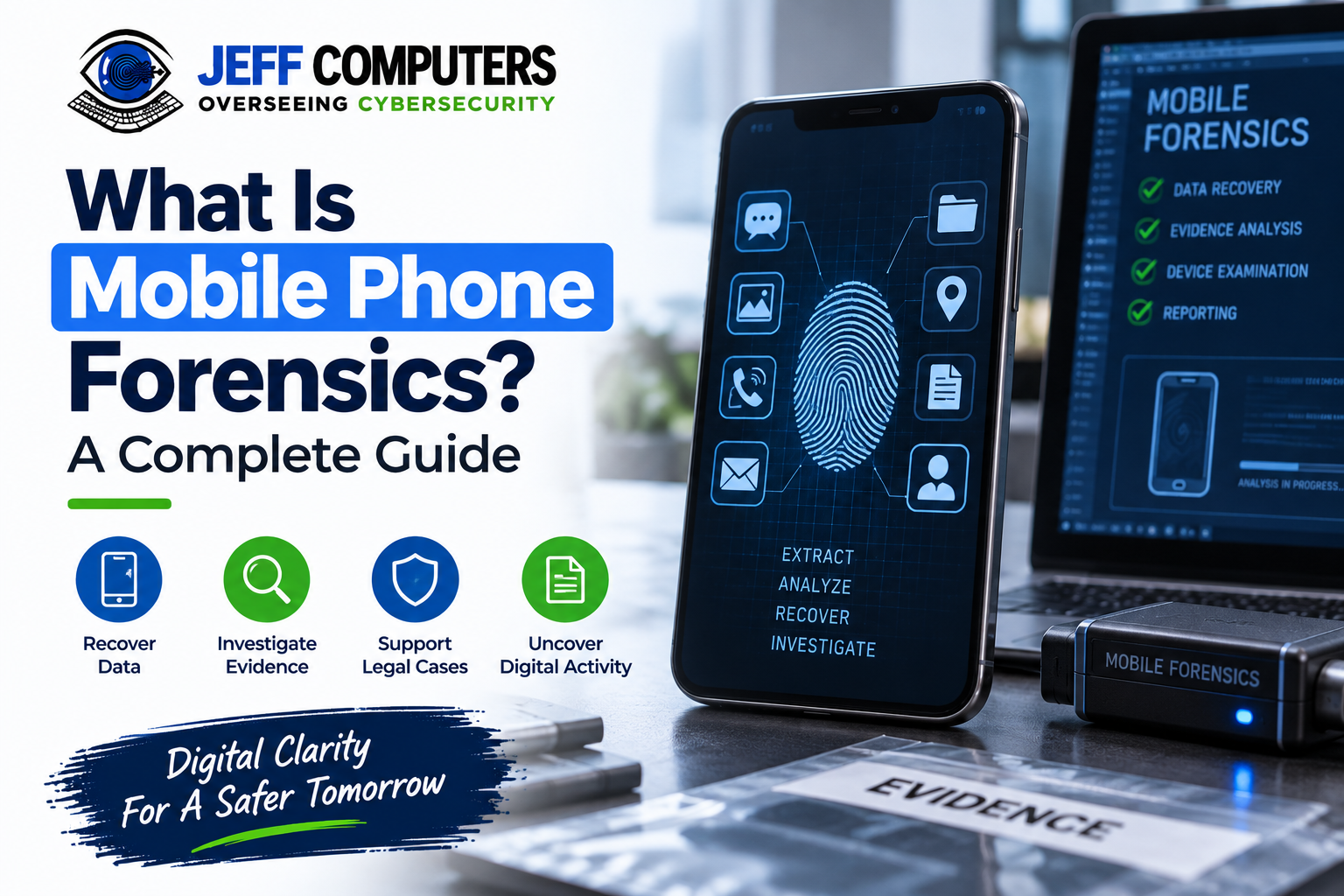
Mobile phone forensics is the scientific process of preserving, extracting, analyzing, and reporting on data stored on a mobile device — smartphones, tablets, and increasingly, wearables and IoT devices — in a way that is legally defensible and admissible in court.
Unlike simply looking through a phone, forensic examination follows a documented, repeatable methodology so that the results can withstand scrutiny in a Florida courtroom, an internal HR investigation, or a federal proceeding. Every step, from the moment the device is seized to the final report, is recorded to preserve what’s known as the chain of custody.
What Data Can Be Recovered?
A qualified examiner can typically recover:
- Call logs and contacts — including deleted entries in many cases
- Text messages and iMessage/RCS data — sent, received, and often deleted
- App data — WhatsApp, Signal, Snapchat, social media, and dating apps
- GPS and location history — cell tower pings, Wi-Fi connection logs, geotagged photos
- Photos, videos, and metadata — including EXIF data showing when and where media was captured
- Browser history and search queries
- Deleted files — recoverable in many cases before they’re overwritten
- System and usage logs — showing when apps were opened, device unlocked, or settings changed
How the Mobile Phone Forensics Process Works
Forensic examiners generally follow four phases:
1. Seizure and Preservation
The device is secured to prevent remote wiping, overwriting, or tampering — often using a Faraday bag to block network signals. This step establishes the starting point of the chain of custody.
2. Data Extraction
Examiners use specialized forensic tools (such as Cellebrite, GrayKey, Magnet AXIOM, or Oxygen Forensic Detective) to create a forensic image — a complete, unaltered copy of the device’s data. Extraction methods vary by device and lock status:
| Extraction Type | What It Captures | Typical Use Case |
|---|---|---|
| Logical extraction | Visible, active files and data | Basic investigations, quick review |
| File system extraction | Databases, app data, system files | Most civil and criminal cases |
| Physical extraction | Full raw data, including deleted items | Deep forensic recovery, criminal cases |
3. Analysis
The extracted data is parsed, decoded, and cross-referenced. This is where timelines are built, deleted content is reconstructed, and artifacts like location data or app activity are correlated to answer the specific question the case requires.
4. Reporting and Testimony
A forensic report documents findings in a way that’s understandable to non-technical audiences — attorneys, judges, juries, or HR professionals — while preserving the technical detail needed for cross-examination. Examiners may also be retained as expert witnesses to testify to their methodology and findings.
Mobile Phone Forensics and Florida Law
Florida has specific legal considerations that make local expertise valuable:
- Daubert Standard: Florida courts apply the Daubert standard (Fla. Stat. § 90.702) for expert testimony, meaning forensic methodology must be shown to be reliable, tested, and generally accepted — not just the examiner’s opinion.
- Florida’s Electronic Surveillance laws: Chapter 934, Florida Statutes governs the interception of electronic communications, which is directly relevant when forensic work touches on messages or call data obtained without a warrant.
- Search warrant requirements: Florida law enforcement generally needs a warrant to search a seized phone’s contents, consistent with the U.S. Supreme Court’s ruling in Riley v. California.
- Family law and civil litigation: Florida’s no-fault divorce framework still allows digital evidence — such as texts or location data — to factor into custody and asset disputes, provided it was obtained legally.
[INTERNAL LINK: /florida-digital-evidence-law “Learn more about Florida digital evidence law”] [EXTERNAL LINK: Florida Statutes Chapter 934, Florida Legislature official site]
Who Uses Mobile Phone Forensics in Florida?
- Law enforcement agencies (Florida Department of Law Enforcement, local police, sheriff’s offices) — criminal investigations, from theft to homicide
- Criminal defense and prosecution attorneys — verifying or challenging digital evidence
- Family law attorneys — infidelity, custody, and harassment cases
- Corporate HR and legal departments — insider threats, IP theft, harassment investigations, BYOD policy enforcement
- Private investigators — civil litigation support
- Individuals — personal safety, stalking, or harassment documentation (always through a licensed examiner to preserve admissibility)
How to Choose a Mobile Forensics Examiner in Florida
When vetting a provider, look for:
- Certifications — such as CCPA/CCO (Cellebrite), GCFE/GCFA (GIAC), or CFCE (IACIS)
- Florida Private Investigator license — required in Florida (Chapter 493, F.S.) for examiners performing investigative work outside law enforcement or an employer relationship
- Court experience — prior expert witness testimony in Florida state or federal court
- Documented chain-of-custody procedures
- Independence and lack of conflict of interest in the specific case
Frequently Asked Questions:
Yes, when performed with proper legal authority — such as a warrant, consent, or a legitimate employer/device-ownership relationship. Extracting data from a device you don’t own or lack authorization to access can violate both state and federal law, including Florida’s computer crime statutes.
Often, yes — especially if the phone hasn’t been used extensively since deletion or hasn’t received the data-overwriting effects of new app installs and updates. Recovery isn’t guaranteed and depends on the device, OS, and elapsed time.
Costs vary widely based on device type, lock status, and scope of analysis, generally ranging from several hundred dollars for a basic logical extraction to several thousand for a full physical extraction with expert report and testimony.
A straightforward extraction can take a few hours to a couple of days; a full investigation with deep analysis and a court-ready report often takes one to three weeks, depending on data volume and case complexity.
Yes, provided the examiner followed an accepted, documented methodology and can demonstrate the chain of custody and reliability of the tools used, satisfying Florida’s Daubert standard for expert evidence.
Key Takeaways
- Mobile phone forensics is a structured, legally defensible process — not simply “looking through a phone.”
- Florida’s legal framework, including the Daubert standard and Chapter 934 electronic surveillance laws, shapes how digital evidence is gathered and used.
- Choosing a properly licensed and certified examiner is critical for both accuracy and admissibility.
- Applications span criminal justice, family law, corporate investigations, and civil litigation across Florida.
If you’re facing a legal matter involving mobile device evidence in Florida, consult a licensed digital forensics examiner and an attorney early — before a device is touched — to preserve its evidentiary value.
Need Certified Mobile Forensics Support in Florida?
Navigating digital evidence correctly the first time can make or break a case. Jeff Computer provides certified mobile phone forensics services for attorneys, businesses, and individuals across Florida — from secure data extraction and deleted content recovery to court-ready reports and expert witness testimony. Every examination follows a documented chain-of-custody process built to meet Florida’s Daubert evidentiary standard, so your evidence holds up when it matters most. Contact Jeff Computer to discuss your case.
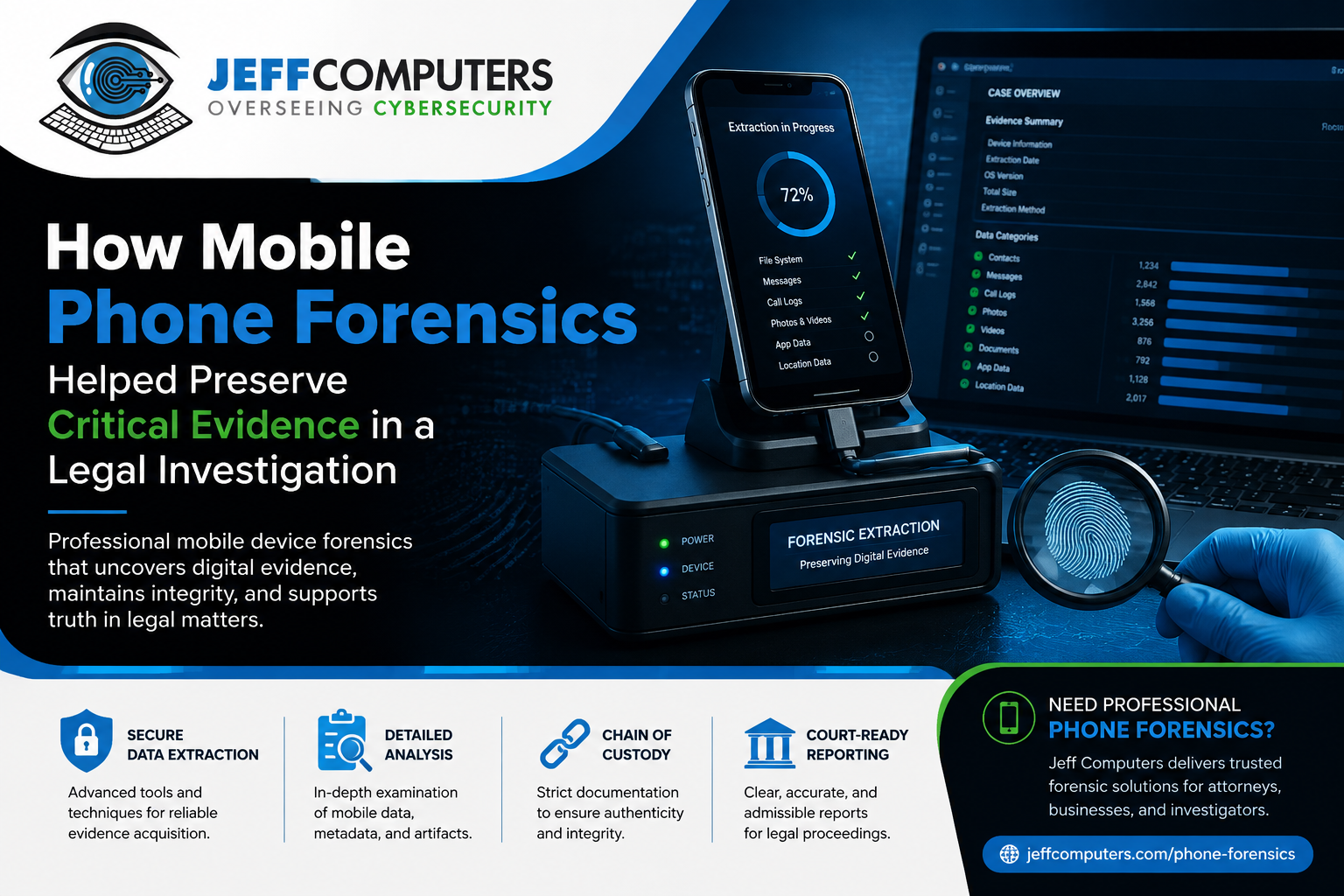
Want to see this process in action? Read our case study, How Mobile Phone Forensics Helped Preserve Critical Evidence in a Legal Investigation, for a real-world look at how proper extraction and chain-of-custody procedures protected key evidence from being challenged in court.