A small business owner in Sarasota fires a sales manager on a Friday. By Sunday, three of the company’s biggest accounts have quietly signed with a competitor. The owner is convinced the manager took client contacts, price sheets, and pipeline notes with him — on his personal phone.
His attorney asks the obvious question: can we prove it?
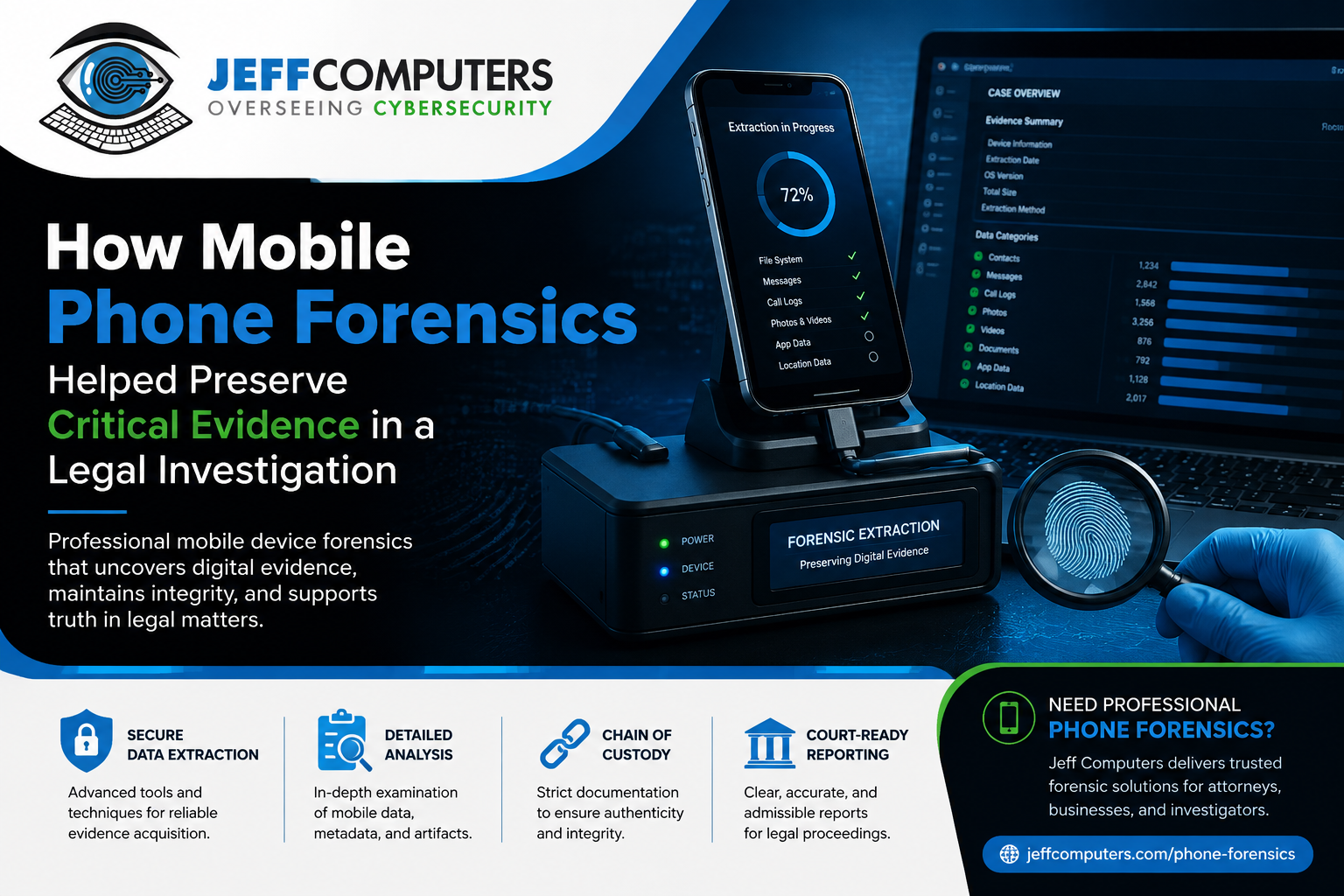
That is where mobile phone forensics comes in. Not the version you see on television. The real one, where a trained examiner uses court-tested tools to pull a verifiable copy of a device, documents every step, and hands the attorney something that will survive cross-examination.
The scenario above is a composite — an illustration built from the kinds of matters phone forensic examiners handle every week. Real cases stay private. But the mechanics are the same across every one of them, and the mechanics are what this article is about.
What mobile phone forensics actually is
Mobile phone forensics is the disciplined process of preserving, extracting, and analyzing the data on a phone, tablet, or other mobile device in a way that a court will accept as evidence.
The word that matters in that sentence is disciplined. Anyone can plug a phone into a laptop and copy files. A forensic examiner does something different:
- Works from a legally authorized position — a signed consent form, a subpoena, a court order, or ownership of the device
- Uses validated tools that produce a bit-for-bit copy of the device’s storage
- Documents every action taken, every tool used, and every person who touches the evidence
- Preserves the original device so it can be re-examined by the other side if needed
- Delivers findings in a report that can be defended under oath
That last point is why businesses hire outside examiners instead of asking their IT person to “just look at the phone.” IT support and forensic work are different disciplines. One fixes problems. The other builds a record that holds up in court.
Chain of custody: the reason forensic evidence stands up in court
If you remember one phrase from this article, remember this one: chain of custody.
Chain of custody is the unbroken paper trail that documents every person who has handled a piece of evidence, when they handled it, what they did with it, and where it was stored between handlings. In a courtroom, evidence without a documented chain of custody is evidence a judge can throw out.
A proper mobile device forensics engagement builds that chain from the first minute:
- Intake — the device is logged with make, model, IMEI or serial number, physical condition, and photographs
- Sealed storage — the device is placed in tamper-evident packaging when not being worked on
- Extraction log — every tool run, every date and time, every examiner initial is recorded
- Hash verification — the extracted image is fingerprinted with a cryptographic hash so any later tampering can be detected
- Report and transfer — the final report references the hash, and every transfer of the device or the data is signed for
If a phone forensic report shows up in court and any link in that chain is missing, opposing counsel has an easy motion to file. If every link is intact, the evidence becomes very hard to challenge.
What can be recovered from a mobile device
This is the section most people skip to. The honest answer depends on the phone, the operating system version, and the condition of the device — but a competent phone forensic analysis can typically preserve:
- Text messages, including many that were deleted
- Call logs and voicemail
- Photos and videos, including metadata showing when and where they were taken
- Emails synced to the device
- App data from messaging platforms, dating apps, ride-share apps, banking apps
- Location history and Wi-Fi network history
- Contacts and calendar entries
- Browser history and downloads
- Notes, voice memos, and documents
Deleted does not always mean gone. When a user deletes a text or photo, the phone marks the storage space as available but often does not overwrite the data immediately. A forensic tool can carve that data back out until the space is reused. This is why time matters — the sooner a device is preserved, the more recoverable data there is.
Two honest limits worth naming:
- Encryption. Modern phones are heavily encrypted. A locked device without the passcode is not always crackable, and no reputable examiner will promise otherwise.
- Cloud-only data. Some data lives only in the cloud, not on the phone. Recovering that usually requires a separate legal process directed at the service provider.
The line every Florida business needs to know about
Florida law is specific about what you can and cannot access on someone else’s device. Florida Statute 934.03 makes it a crime to intercept certain electronic communications without proper authorization, and related statutes cover unauthorized access to stored communications.
Translated into plain English: you cannot hand a suspected-cheating spouse’s phone to a forensic examiner unless you have legal authority to do so. Ownership of the device, a signed consent, a subpoena, or a court order are the paths that make an examination lawful. A trustworthy examiner will ask about the legal basis before touching the phone and will decline the work if the basis is not there.
This is not a limitation. It is what makes the resulting evidence usable. Findings pulled from an unauthorized examination are not just inadmissible — they can create criminal exposure for the people who ordered them.
The forensic process, step by step
Here is what a mobile device examination actually looks like when done properly.
Step 1 — Legal authorization review. The examiner confirms who owns the device, who is asking for the exam, and what authority permits it. Nothing else happens until this is clear.
Step 2 — Intake and isolation. The device is documented, photographed, and placed in airplane mode or a Faraday bag so no remote wipe command can reach it. Remote wipe is a real risk — a former employee who realizes his old phone is being examined can trigger it from any browser.
Step 3 — Extraction. Using industry-standard tools — Jeff Computers uses Cellebrite and Oxygen Forensics, the same platforms trusted by law enforcement agencies — the examiner pulls a complete image of the device’s storage. Depending on the phone, this may be a logical extraction, a file system extraction, or a full physical extraction.
Step 4 — Verification. The image is hashed. That hash is recorded and referenced in the final report. Any later question about whether the data was altered can be answered by re-hashing and comparing.
Step 5 — Analysis. The examiner searches, filters, and reconstructs the data relevant to the matter. In a departing-employee case that might mean outbound messages to competitors in the last thirty days. In a custody matter it might mean location history for specific dates.
Step 6 — Reporting. The findings are written up in a report that a non-technical judge or jury can follow, with exhibits, timestamps, and references back to the source data.
Step 7 — Testimony. If the case goes to hearing or trial, the examiner is available to authenticate the report under oath.
When you actually need mobile phone forensics
Not every problem needs a forensic examiner. But some do, and getting the right help early is the difference between a strong case and a lost one.
Common situations where phone forensics services earn their fee:
- A departing employee suspected of taking trade secrets, client lists, or files
- Workplace harassment claims where key evidence lives in texts or DMs
- Family law matters where communications, location, or app activity are at issue
- Business disputes where a contract or negotiation happened over messaging
- Suspected embezzlement or fraud with a mobile-app trail
- Any matter where an attorney needs mobile evidence extraction that will survive challenge
If you are an attorney, the earliest phone call is usually the most valuable one. Preserving a device the day it comes into your possession is far cheaper — and produces far better evidence — than trying to reconstruct data weeks later.
Frequently asked questions
Is data recovered through mobile device forensics admissible in Florida courts? +
How long does a phone forensic analysis take? +
Can deleted text messages really be recovered? +
Do I need a court order to have my own company phone examined? +
What is chain of custody in digital evidence collection? +
What tools do forensic examiners use? +
When mobile evidence matters, get it right the first time
The worst time to learn that your evidence was collected the wrong way is in a hearing. By then, the device has been powered on and off, apps have overwritten data, and any chance of a clean forensic image is gone.
Jeff Computers has been the neighborhood technology shop in the Osprey and Sarasota area for years, and our phone forensics practice brings that same clear, plain-English approach to a technical field that usually feels intimidating. Every examination is handled under proper legal authority, with documented chain of custody, using court-tested tools.
If you are an attorney with a matter that may involve mobile evidence, or a business owner facing a situation where a phone’s data will decide the outcome, the right first step is a conversation before anything else happens to the device.
Learn more about our approach on the Phone Forensics service, or call Jeff Computers to talk through your matter with someone who will speak in plain English and tell you honestly whether forensics is the right tool for what you are facing.