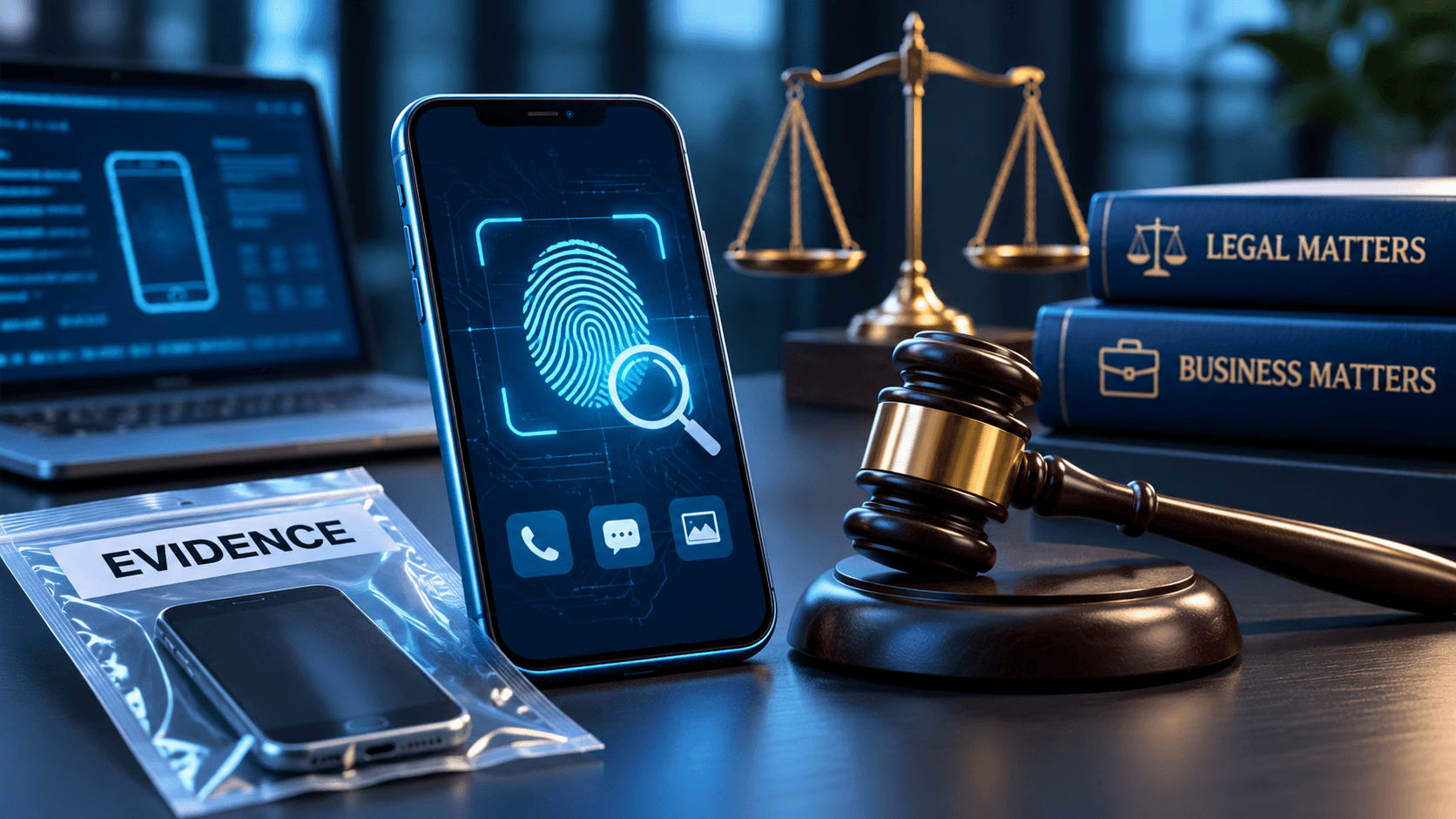

Quick answer: Smartphone digital evidence can help establish what communications were recorded, when certain activity may have occurred, and which electronic records are relevant to a dispute. Text messages, call logs, photographs, location-related records, app data, and metadata may support civil, family-law, business, and criminal cases. However, no single smartphone artifact automatically proves who used the device, who wrote a message, or whether the evidence is admissible in court.
When digital evidence from smartphones matters to a legal case, lawful access, careful preservation, accurate interpretation, and documentation are as important as the data itself. This guide explains what mobile-device records can—and cannot—show, how cell phone forensics may help, and what people in Sarasota and throughout Florida should consider before a device is examined.
What Is Digital Evidence From a Smartphone?
Smartphone digital evidence is information stored on, generated by, or lawfully accessible through a mobile device that may be relevant to an investigation or legal dispute. Some records come from the phone itself; others may exist in authorized backups or associated services. Available information depends on the device model, operating system, settings, encryption, app behavior, and retention policies.
Important distinction: A recorded fact is not always proof of a person’s conduct. For example, an app may show a timestamp, but that timestamp alone may not identify who held the phone or explain why an action occurred.
What Types of Smartphone Evidence Can Support Legal Cases?
| Evidence type | Potential relevance | Important limitation |
|---|---|---|
| SMS, iMessage, and chat data | Available message content, participants shown, dates, and chronology | Account or contact details do not necessarily prove authorship |
| Call logs | Records of calls and associated numbers | A call log does not establish what was said |
| Photos and videos | Visual information and available file properties | Media can be edited, forwarded, or stripped of metadata |
| GPS and location artifacts | Possible locations or movements of a device | Precision varies; a device’s location is not proof of who carried it |
| Email and application records | Potential communications, account activity, or app events | Encryption, syncing, and retention can limit access |
| Files and browser artifacts | Available documents, downloads, or browsing traces | Artifacts may not reliably identify a user or intent |
| Metadata and timestamps | Context about creation, modification, and sequence | Time zones, clock settings, and transfers may change interpretation |
For a broader technical introduction, see What Is Mobile Phone Forensics? A Complete Guide.
How Smartphone Digital Evidence Helps in Different Legal Matters
Family-law and civil disputes
Available messages or media may help attorneys evaluate the timing and context of communications, contractual disagreements, or other disputed facts. A phone examination can document technical observations, but an examiner does not determine what those observations legally prove.
Business and employment investigations
Subject to lawful authorization, phone records may help examine suspected sharing of confidential information, communications related to a transaction, or activity associated with company systems. Device ownership does not, by itself, resolve all employee privacy or access issues; businesses should seek legal guidance on scope and permissions.
Fraud, harassment, threats, and criminal matters
Messages and related records may corroborate a timeline, identify potential leads, or help evaluate whether a communication was preserved in context. Technical evidence should be interpreted alongside other evidence and appropriate legal processes. If safety or criminal activity is involved, coordinate with legal counsel or relevant authorities.
These scenarios are illustrative, not descriptions of particular Jeff Computers clients or case outcomes.
Are Text Messages and Screenshots Admissible in Court?
Text messages, screenshots, and app conversations can be admissible, but not automatically. Florida’s 2026 Statutes § 90.901 requires authentication: enough evidence to support a finding that an item is what its proponent claims. Other issues, including relevance, hearsay, collection methods, and case-specific rules, can also affect admissibility.
A screenshot may truthfully depict what someone saw on a phone, but it may not contain the full conversation, original metadata, or sufficient context to answer a dispute about its source. On the other hand, a forensic extraction is not automatically required to authenticate every screenshot. Witness testimony, other records, and the surrounding circumstances may be relevant.
Federal proceedings have their own rules. Federal Rule of Evidence 901 addresses authentication; Rule 902 provides certification routes for certain electronic records and copied digital data. An attorney should determine which rules apply to a particular matter.
Screenshots vs. Forensic Phone Extractions
| Screenshots | Documented forensic examination |
|---|---|
| Capture information visible on the screen | May access and analyze relevant underlying data artifacts |
| Fast to collect and explain | Requires lawful access, defined scope, and technical methods |
| May omit surrounding context or metadata | May provide additional technical context, subject to device limitations |
| May be authenticated and admitted | May support authentication, but cannot guarantee admissibility |
In a straightforward matter, a screenshot together with a knowledgeable witness may be sufficient. In a dispute involving completeness, alteration, or complicated device behavior, a forensic examination may be helpful. The right choice depends on the legal question—not on a promise that one form of evidence is always superior.
Can Deleted Text Messages, WhatsApp Chats, or Photos Be Recovered?
Sometimes. There is no guaranteed recovery method for every smartphone. Results depend on the device, operating system, storage encryption, app settings, how much time has passed, and whether authorized backups or other records exist. A deleted message might remain in an available backup or related artifact; it may also be permanently unavailable.
Modern iPhones and Android devices frequently use strong encryption and storage-management features that limit recovery. A reliable cell phone forensic examiner should explain the likely scope of the examination and document unsuccessful or inconclusive results rather than promise universal access.
How Smartphone Evidence Is Preserved for a Legal Investigation
The National Institute of Standards and Technology (NIST), SP 800-101 Rev. 1, describes mobile-device forensic work in terms of preservation, acquisition, examination, analysis, and reporting. A case-specific workflow may involve:
- Legal authorization and scope: Confirm appropriate permission or legal process and determine which questions the examination should answer.
- Device intake documentation: Record device details, condition, custody, and relevant circumstances.
- Evidence preservation: Reduce avoidable changes while accounting for device security and possible active threats.
- Data acquisition: Use an appropriate extraction method and document tools, settings, and limitations.
- Technical analysis: Evaluate relevant records, correlations, timestamps, and alternative explanations.
- Reporting: Explain methods, observations, limitations, and findings in a form understandable to the intended audience.
Chain of custody is the record of who collected, transferred, stored, and examined evidence and when. When a forensic copy can be made, integrity checks such as cryptographic hashes can help compare copies. Not all smartphones or acquisition methods permit a complete bit-for-bit image, so the examiner should accurately describe what was and was not obtained.
See our related article, How Mobile Forensics Preserves Critical Legal Evidence, for more on evidence handling.
What Should You Do if a Smartphone May Contain Important Evidence?
- Don’t factory reset or erase the phone. Avoid deleting messages, reinstalling apps, or experimenting with recovery tools.
- Record basic context. Write down relevant dates, circumstances, accounts, and what you observed without changing the underlying records.
- Preserve authorized related sources. Ask counsel whether original messages, backups, or account records should also be retained.
- Respect privacy and access limits. Do not enter someone else’s phone or accounts without valid permission or lawful authority.
- Get case-specific help. If there is an active compromise or risk of remote wiping, professional guidance can help balance preservation and security.
If unauthorized access is your concern, read Phone Hacked in Sarasota, FL? Get Professional Help.
When Should You Hire a Cell Phone Forensic Examiner?
A documented examination can be useful when the source or completeness of a message is disputed, app data needs technical interpretation, potentially deleted information is relevant, or an attorney requires a clear account of what accessible device records show. Before hiring anyone, ask about experience, device support, collection permissions, data security, scope, costs, and reporting limitations.
Not every investigation needs a full extraction, and no examiner can promise that a specific record will be recovered or accepted by a court.
Digital Forensics Services in Sarasota, Florida
Jeff Computers works with individuals, businesses, and legal professionals in Sarasota, Osprey, Venice, Nokomis, and surrounding Florida communities. If smartphone evidence may be relevant to a dispute or investigation, start with a conversation about the device, lawful authority, evidence-preservation concerns, and what technical examination could realistically address.
Visit Digital Forensics Services in Sarasota, FL to explore our investigation and evidence-handling approach, or learn about Phone Forensics services.
Contact Jeff Computers: (941) 263-0705. Do not send passwords, private conversations, or sensitive evidence through an unsecured contact form.
Frequently Asked Questions About Smartphone Digital Evidence
Select a question below to view the answer.
Can text messages be used as evidence in court?
Yes. When relevant and adequately authenticated, text messages may be admitted subject to applicable evidentiary rules. The specific foundation depends on the case.
Are screenshots of WhatsApp messages enough?
Sometimes. A screenshot may be useful evidence, but authentication, context, completeness, and any objections matter. A forensic extraction is not mandatory in every case.
Can a phone forensic examiner recover deleted messages?
Sometimes, depending on encryption, app storage, backups, retention, device condition, and authorized access. No recovery can be guaranteed.
Can GPS location history prove a person was somewhere?
Location data may help evaluate where a device was, with varying accuracy. It does not independently prove which person possessed or operated that device.
What is metadata in smartphone evidence?
Metadata is information about a digital record, such as a stored timestamp or file property. Its significance depends on how the record was generated, changed, and preserved.
What is chain of custody in digital forensics?
It documents the handling and transfer of potential evidence. Good documentation supports credibility but does not automatically make the evidence admissible.
Can an employer examine an employee’s personal phone?
Whether access is permitted depends on consent, ownership, privacy expectations, policies, and applicable law. Employers should seek legal advice before examination.
How much does phone forensics cost in Sarasota?
Cost depends on the device, technical access, required analysis, and reporting needs. Request an estimate based on the scope of the case.
How long does smartphone forensic analysis take?
Timeframes vary depending on authorization, device condition, encryption, available data, and deliverables. Ask for a case-specific estimate.
Sources, Methodology, and Legal Disclaimer
References: NIST Guidelines on Mobile Device Forensics (SP 800-101 Rev. 1); 2026 Florida Statutes § 90.901; Federal Rule of Evidence 901; and Federal Rule of Evidence 902. NIST’s 2014 publication is cited for foundational examination principles; current device capabilities vary.
This article is general educational information, not legal advice. Court admissibility depends on applicable law, authentication, relevance, and judicial rulings. Seek advice from qualified legal counsel regarding consent, evidence collection, discovery, and the requirements of your case.